The Shared Socket: Fair Play and Fine Print for Charging at Work
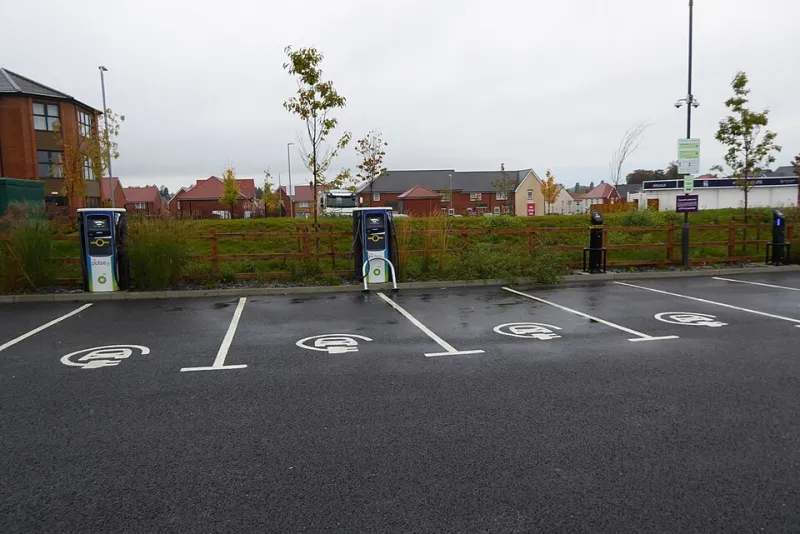
Photo: Philip Halling , CC BY-SA 2.0, via Wikimedia Commons
Workplace charging has a habit of sounding simpler than it is. You arrive, plug in, and by home time the car has quietly gained enough range to cover the school run and the trip to the tip. For many UK drivers, it is the most useful EV perk going. It is also the point where colleagues who barely discuss anything more controversial than the kettle start having surprisingly detailed conversations about electricity, parking priority and who exactly is picking up the bill.
The perk with a queue
The first thing to accept is that workplace charging is rarely unlimited. Even a bank of seven or eight chargepoints can look generous until half the office arrives in electric cars and the morning meeting turns into a low-level negotiation about who gets the 7kW socket nearest the door. The practical answer is not to pretend the resource is infinite. It is to find out how the scheme is meant to work before you build your weekly routine around it.
Ask facilities or HR for the written policy, not the pub version. Does charging cost you anything? Is there a booking system, an app, a rota, or an honesty box? Are the bays for employees only, or can visitors use them? Are they intended for top-ups or full charges? A policy that exists only in someone's head will cause more friction than a slightly imperfect one that everyone can read.
What free actually means
Free workplace electrons are not free to the business. Someone pays for the supply, the chargepoint maintenance, the back-office software and the person who fields the emails when a connector will not release. That does not mean employees should feel guilty about using a benefit. It does mean drivers should be honest about what they are using it for.
A fair scheme usually has a clear purpose. Some employers offer charging as a low-emission commuting perk. Others provide it mainly so staff in company cars can top up between appointments. Others simply want to encourage EV take-up and accept that the electricity bill is part of that. The fairness question changes depending on which of those is true. If the bays are there for business mileage, using one to fill your personal car every Friday may not go down well. If they are a general staff benefit, a rota is usually fairer than first-come-first-served anarchy.
Tax: the bit nobody wants to read
The tax treatment of workplace charging can be less straightforward than the plug suggests. It depends on who owns the car, how the scheme is set up and whether the charging is provided as a general workplace facility or as part of a more specific arrangement. Company-car drivers usually find electricity is treated differently from petrol or diesel, but free workplace charging should still be checked against the benefit-in-kind rules rather than assumed to be invisible.
For employees charging their own electric cars at work, the position can vary. Some workplace charging arrangements are accepted as a tax-free facility; others may need more careful handling. This is not the place for a definitive ruling, and it is certainly not a reason to guess. If your employer offers free charging, ask payroll or HR how they treat it. If you are the person designing the scheme, get proper advice before telling staff it is all completely tax-free. A short conversation now is cheaper than unpicking a benefit-in-kind question later.
When there are more cars than cables
Access is where workplace charging gets emotional. Nobody likes arriving to find the one working connector occupied by a car that has been sitting at 100% since 9.15am. A few practical rules keep the peace:
- Set a maximum stay if the chargepoint is in demand. Four hours is plenty for many commuters; a full day is not.
- Ask drivers to move their cars once charging finishes, even if the bay is not needed immediately.
- Use a booking system if the site has one, and actually cancel if your plans change.
- Give priority to drivers who cannot charge at home, not simply to those who arrived earliest.
- Keep visitor bays separate if possible, so guests are not forced into a debate about the staff rota.
The last point matters more than it sounds. A workplace charger that is always blocked by staff cars is not much use for the electric van delivering samples or the client who arrived in a borrowed EV. Good schemes think about the whole site, not just the people with permanent desks.
Reimbursement if you are charging for work
There is a separate question if you use your own electric car for business journeys and rely on workplace charging to keep it topped up. If your employer reimburses business mileage, ask whether they use HMRC's advisory electricity rate or an actual-cost method. Many organisations use the advisory rate because it is simple; others prefer receipts and calculated kWh. Either can work, but the method should be agreed before you submit a claim.
The awkward middle ground is the commute. Charging at work for the journey home is generally a personal-use benefit, not a business expense, unless your employer has a specific arrangement. Do not assume that because the car is electric, every electron is automatically outside the payroll rules. A little clarity from the finance team saves a lot of eye-rolling later.
Etiquette that keeps the peace
Workplace charging etiquette is mostly ordinary courtesy with a plug attached. Do not unplug another car unless the policy explicitly allows it and the owner has agreed. Leave the cable tidy. Report faults rather than silently abandoning a dead connector. If you are going to be late back, move the car before the meeting overruns. And if you are the person who always gets the same bay, consider whether that is because you are organised or because everyone else has given up asking.
A shared spreadsheet or app can feel bureaucratic, but it is better than a passive-aggressive note on the windscreen. Many chargepoint operators provide usage logs, so a fair rota is easier to run than it used to be. If your workplace has no system at all, suggest a simple one. The alternative is usually a slow drift into resentment, which is a strange outcome for a perk designed to make green motoring easier.
Before you rely on it
Workplace charging is a useful part of UK EV ownership, but it should not be the only leg holding up your weekly routine. Treat it as a bonus rather than a guarantee. Check the policy, understand the tax position, agree how access works and keep a home or public charging fallback for the weeks when the office socket is busy, broken or reserved for someone else.
Do that, and the office chargepoint stays what it should be: a genuinely helpful perk, not a daily source of quiet friction.