Tread Carefully: What All-Season Tyres Really Cost an EV Over Three Years
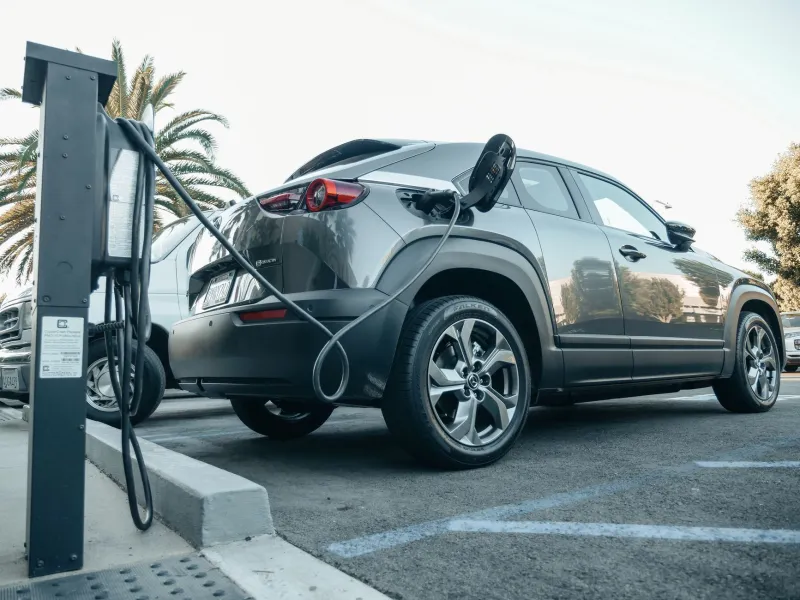
There's a moment, usually around the second MOT, when an EV owner looks at a tyre invoice and wonders whether the car is quietly eating money. It isn't imaginary. Battery packs add a few hundred kilos, electric motors deliver full torque from a standstill, and the result is a set of tyres that often bows out somewhere between 18,000 and 28,000 miles rather than the 35,000 you might have seen on a petrol hatchback.
So the question isn't really "are all-season tyres good?" It's narrower and more awkward: is one set of all-seasons cheaper and simpler than the traditional two-set shuffle, given how most of us actually drive in the UK?
Why an EV is harder on rubber
Three things are happening at once. First, mass. A family-sized electric crossover can tip the scales at 1,900kg before you've loaded the dog. Second, torque. Every pull away from a roundabout asks the front tyres to do something they'd rather not.
Third — and this is the bit people miss — many EV-specific tyres are engineered around low rolling resistance, which means a harder compound and a stiffer sidewall. That buys range. It doesn't always buy wet grip, and on a cold, greasy B-road in February you'll feel the difference.
Regenerative braking does claw some life back, since the rear brakes and rear tyres aren't working as hard under deceleration. It rarely offsets the weight and torque penalty entirely.
What "all-season" means in a British context
Ignore the M+S marking on its own — it's a self-declaration and means very little. What you want is the three-peak mountain snowflake (3PMSF) symbol, which confirms the tyre has passed a genuine snow traction test.
That matters because our climate is a strange middle ground. Most of the country sees a handful of snow days a year, if that. What we get in abundance is standing water, damp mornings at 4°C, salt residue, and the occasional 30°C week in July that makes a soft winter compound feel like chewing gum.
A decent all-season sits between those poles. It won't match a dedicated winter tyre on packed snow in the Cairngorms, and it won't match a premium summer tyre on a dry track day. For the school run, the M25 and a fortnight in Cornwall, that compromise is usually the right one.
The £200 question, costed
Let's use a realistic size — 235/45 R18, common on mid-range electric hatchbacks and crossovers.
Route one: all-seasons on one set of wheels. Four mid-range all-seasons, fitted and balanced, land around £130–£150 each, so roughly £560. At 22,000 miles per set, over three years and 30,000 miles you're buying about 1.4 sets: call it £780 including a couple of alignments. That works out at 2.6p per mile.
Route two: summers plus winters. A summer set at £110 a corner is £440 and might last 26,000 miles. A winter set at £520 will outlast the car's ownership in most of England because you're only doing 2,000 miles a season on them. But you'll want a second set of wheels (£300–£400), and two swaps a year at £50–£70 a go adds £120–£140 annually.
Over the same three years you're looking at roughly £1,230 all in — about 4.1p per mile, plus the faff of storing four tyres in the garage and booking a fitting slot in the week everyone else remembers it's November.
On pure arithmetic, then, all-seasons win for most drivers. The £200 question is really whether you're one of the exceptions: rural Scotland, a steep un gritted lane, or a commute that crosses a moor.
Efficiency and noise: the small print
Here's where all-seasons take a gentle hit. A grippier, more siped tread pattern usually means slightly higher rolling resistance — typically 2–4% worse than a low-resistance summer tyre.
On 10,000 miles a year at 3.5 miles per kWh and 25p per kWh, you're spending about £714 annually on home charging. A 3% efficiency penalty is roughly £21 a year. Not nothing, but hardly a dealbreaker.
Noise is more noticeable. Expect one to two decibels more than a dedicated summer tyre, and check the EU label — anything at 70dB or below is civilised on a car with a quiet cabin. Some all-season patterns also drone in a specific band between 50 and 70mph, which is exactly where you'll spend your motorway hours. Read owner reports for your size before committing.
A buying framework that actually helps
Rather than brand loyalty, work through these in order:
- 3PMSF marking — non-negotiable if you want winter credibility.
- Wet grip A on the EU label. This is the single most useful number for UK driving.
- Rolling resistance B or better — you're giving up enough range already.
- Correct load and speed rating. EVs are heavy; don't drop below the placard figure to save £8 a corner.
- EV-approved where offered. Extra load index and acoustic foam are genuine benefits, not marketing.
- Price per mile, not price per tyre. A £170 tyre that lasts 30,000 miles beats a £110 tyre that lasts 16,000.
Living with them
Three habits stretch any tyre's life on an EV. Check pressures monthly — an EV is sensitive to under-inflation and you'll lose range as well as tread. Rotate front to rear every 6,000 miles or so, because the driven axle wears noticeably faster. And don't run them to the 1.6mm legal limit: wet grip falls away sharply below 3mm, and on a 1,900kg car that gap is felt, not theorised.
Get the alignment checked once a year too. A knock from a pothole can scrub a shoulder bald in a few thousand miles, and it's £50 to fix versus £560 to replace.
The honest conclusion: for the majority of UK EV drivers, a good all-season set is the sensible, quietly money-saving choice — provided you buy on wet grip and wear rate rather than the picture on the sidewall.